Engineering students create first autonomous vehicle to drive on a Canadian road
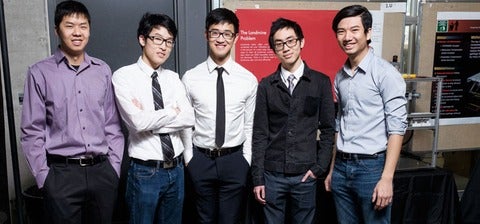
Two second-year mechatronics students have developed a self-driving vehicle that is the first to travel on a Canadian road.
Waterloo Engineering automotive research projects are receiving financial support from the Canada Foundation for Innovation's (CFI) Automotive Partnership Canada Fund. The two initiatives will help improve fuel efficiency: one by developing lightweight parts and the other by designing intelligent control systems.
Electrical and computer engineering faculty members and a doctoral candidate have been honoured with best paper awards.
Adam Neale and Manoj Sachdev, both electrical and computer engineering professors, have been awarded the Custom Integrated Circuits Conference 2014 Best Poster Paper Award for their work entitled "A 0.4 V 75 kbit SRAM Macro in 28 nm CMOS Featuring a 3-Adjacent MBU Correcting ECC." They'll be presented with their award at the keynote session of CICC 2015 being held in San Jose, California next month.
Canadian Foundation of Innovation funding of $30 million for the development of an advanced research computing facility will enable Canadian researchers to gain a deeper understanding of how the scientific, social, health and economic worlds connect.
Amir Khandani, an electrical and computer engineering professor was awarded $75,000 from the Canada Foundation for Innovation for his work on infrastructure for 5G wireless cellular networks and the Internet of Things.
For the second time in two years, two Waterloo Engineering startups have been chosen out of hundreds of others as contenders for the 2015 James Dyson Award.
Grasp and Voltera V-One, both founded as Capstone Design projects, are among five Canadian finalists for the award.
As in past Velocity pitch competitions, Waterloo Engineering students captured the majority of awards at July's Velocity Fund Finals, including the top four $25,000 prizes. The winners included:
Pearl Sullivan, dean of engineering, Mike Kirkup (MMSc ‘07, MSci), Michael Litt (BASc '10, SD), Rachel Pautler (BASc' 15, Nano), and Ted Livingston, a former engineering student are featured in a Globe and Mail article entitled Startup city: The high-tech fever reshaping Kitchener-Waterloo, part of a series written by Shane Dingman, the Globe's technology reporter. Each article explores burgeoning tech companies on the rise in various parts of Canada, the challenges they face and how locales are supporting their rising stars.
Waterloo's award-winning Engineering Science Quest program had humble beginnings. Started as a fourth-year project by a science student and an engineering student in 1990, it was launched as a camp the following summer for kids in Grades 5 and 6.
ESQ now offers multiple summer camps on the main Waterloo campus for boys and girls entering Grades 1 to 9. It also offers March break, Winter break, after school and weekend programs, as well as various in-school and community initiatives. Satellite programming is provided in various rural and aboriginal locations throughout Ontario.
Two management engineering teams won the top two awards in the undergraduate category at this year's Canadian Operations Research Society (CORS) 2015 Student Paper Competition held in Montreal. A third team placed in the competition's top five. All the students' papers were also their 2015 Waterloo Engineering Capstone Design projects.