News

Filter by:

Limit to news where the title matches:
Limit to items where the date of the news item:
Date range
Limit to news items tagged with one or more of:
Limit to news items where the audience is one or more of:

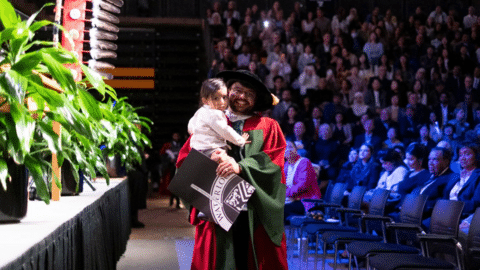
More than 460 engineering and architecture students celebrated the end of their academic journey on Saturday, October 24, as they received their degrees from the University of Waterloo at Fall 2026 Convocation.

With family, friends and the Faculty of Engineering and School of Architecture community in attendance, 123 undergraduate, 290 master’s and 50 PhD graduates crossed the stage during the afternoon ceremony on campus.


A three-time Waterloo Engineering alum has been formally installed as president and vice-chancellor of the University of Waterloo, becoming the first graduate to lead the institution.

Dr. Bill Rosehart (BASc ’96, MASc ’97, PhD ’01), who earned all three degrees in electrical and computer engineering, was installed as the University’s eighth president during a ceremony on October 22, 2026. 

Waterloo Engineering doctoral students have secured $2.4 million in the first round of the Canada Graduate Research Scholarships – Doctoral, the federal government’s new award for outstanding doctoral researchers.

Twenty students from across the Faculty earned the scholarships, each worth $120,000 over three years. Winners were chosen equally on their research potential and on their experience and achievements inside and outside academia.

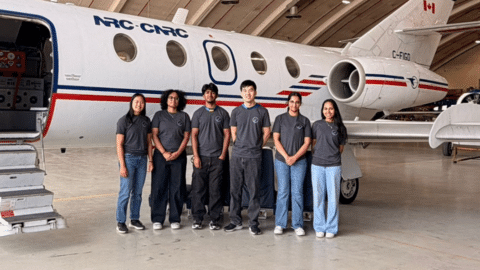
A Waterloo Engineering student design team has taken another step toward repairing electronics in space by designing, building and testing an automated soldering device aboard a microgravity flight.

The Waterloo Space Soldering Team, made up of 17 students and recent alumni, was one of four teams across Canada selected by Students for the Exploration and Development of Space Canada for this year's Canadian Reduced Gravity Experiment Design Challenge, held August 31 to September 4.

Two of the country's biggest student-led tech events landed in Waterloo this September, attracting students, alumni, business founders and investors from around the world, reinforcing the region's status as the place for startups and tech talent in Canada.

Hack the North, now in its 13th year, welcomed more than 1,000 participants for a 36-hour hacking sprint that produced 353 projects. Waterloo Tech Week — in only its second year — connected founders, talent scouts and venture capitalists across the startup community.

A member of the first cohort of Waterloo Engineering's Rising Stars Fellowship — a paid summer research program for undergraduates — is one of seven fellows who've returned to the University of Waterloo for graduate study since the program began in 2024.

David Carciente is now pursuing a master's degree in the Department of Systems Design Engineering, after spending his 2024 Rising Stars summer in Waterloo's Vision and Image Processing Lab building a computer vision tool that helps marine researchers identify whales in satellite imagery.

Two members of Waterloo Engineering's leadership team have been re-appointed to Associate Dean roles for new terms.

Dr. Mary Wells, Dean of Engineering, announced the reappointments of Dr. Carolyn MacGregor and Dr. Derek Rayside. MacGregor's new one-year term as Associate Dean, Teaching and Community runs from September 1, 2026 to August 31, 2027. Rayside's new three-year term as Associate Dean, Co-operative Education and Professional Affairs runs from September 1, 2026 to August 31, 2029.

A University of Waterloo adjunct professor and staff member has been recognized on a national list celebrating some of the country's top rising engineering talent.

Dr. Brandon DeHart, manager of Waterloo's RoboHub, was among a group of rising Canadian engineers profiled in Design Engineering magazine's June 2026 feature, "Geared for Success," which highlights engineering professionals up to age 40 who are making their mark in the field.

Researchers from Waterloo Engineering have received more than $2.9 million in combined funding through the Natural Sciences and Engineering Research Council of Canada's (NSERC) Discovery Grants program.

In total, 47 Waterloo Engineering researchers across seven departments and schools received funding this year, spanning three streams of the program.